Case Study - Regenerate Hub – Expanding Access to Sustainable Development Data
Product and research direction for digital platform aggregating sustainability data across Lebanon, using user research and participatory design to make complex environmental information accessible across NGOs, policymakers, and communities—with secondary insights into collaboration patterns that can inform institutional space design.
Visit Regenerate Hub's site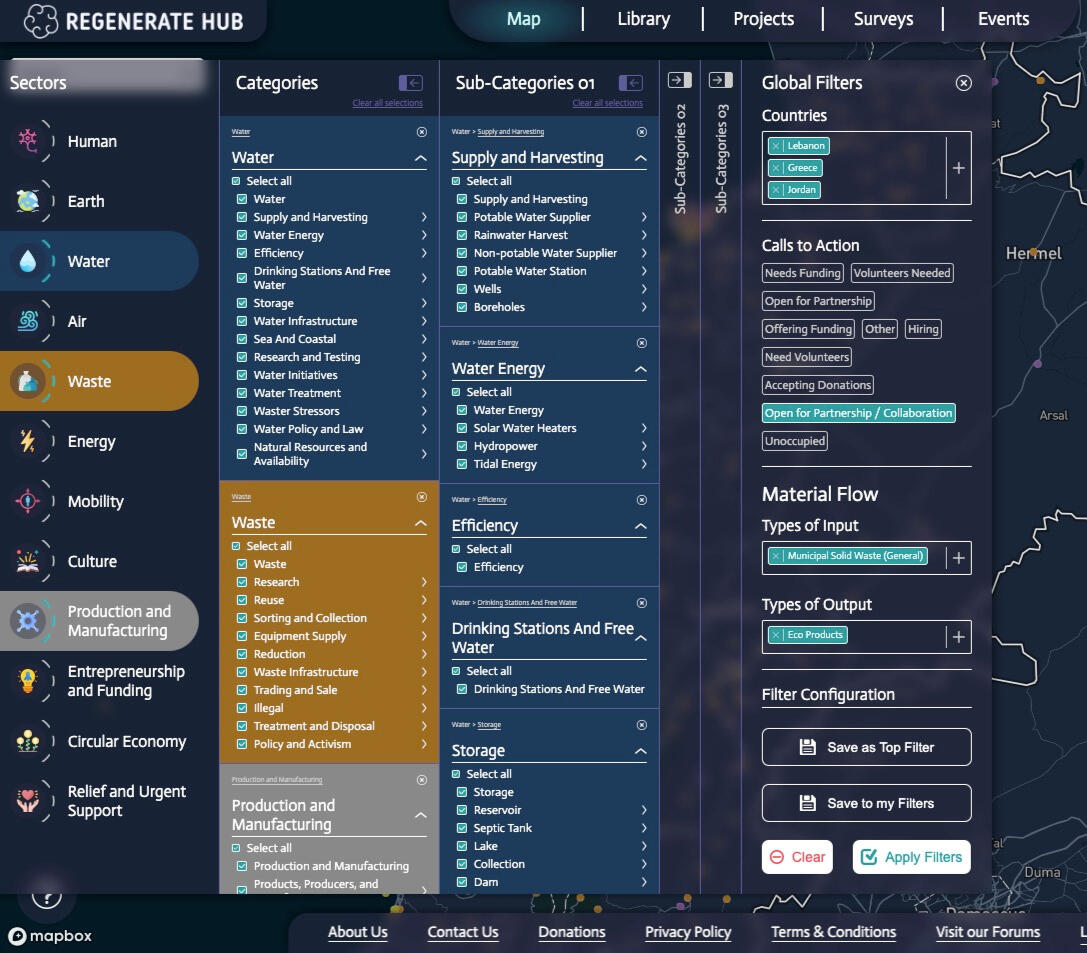
- Client
- Recycle Lebanon – Regenerate Hub
- Service
- Product & Research Direction, UX Research, Stakeholder Engagement, Information Architecture
- Location
- Lebanon (globally accessible platform)
- Date
- 2019–2024
Overview
Regenerate Hub is a digital platform that connects environmental harms with social and circular economy solutions, making sustainability data accessible to NGOs, policy makers, and communities in Lebanon. As Product and Research Director, Rachel led user research, participatory design, and product strategy for the beta platform and subsequent iterations.
Although the core output was digital, the work surfaced where and how cross‑sector collaboration actually happens—online, in offices, and in informal meeting spaces—and what different stakeholders need to work together productively. For architects and planners, the project demonstrates how rigorous user research and information architecture can reveal where collaboration actually occurs and what environments support it. These insights can inform programming and layout for campuses, research hubs, and civic buildings intended to serve as regional centers for climate and sustainability work—ensuring built spaces align with real collaboration patterns instead of idealized ones.
The Challenge
Sustainability and environmental justice actors in Lebanon hold critical data, but it is scattered across reports, websites, and personal networks. This fragmentation makes it difficult to see:
- Where environmental harms are concentrated.
- Which circular or sustainable solutions already exist.
- How policies, funding, and grassroots initiatives align—or work at cross‑purposes.
Regenerate Hub needed to:
- Aggregate diverse datasets in a technically robust, publicly accessible way.
- Present complex information in interfaces usable by non‑technical users.
- Reflect the cultural, sociopolitical, and ecological context of Lebanon in how data is organized and visualized.
Approach
Phase 1: Discover – User & Stakeholder Research
- Conducted interviews and participatory sessions with NGOs, policy partners, activists, and public users to understand how they currently find, interpret, and act on sustainability data.
- Used journey mapping and participatory design sessions to trace real scenarios: planning campaigns, drafting policy, identifying partners.
- Identified key pain points around discoverability, trust in data, and the difficulty of connecting harms with concrete solutions.
Phase 2: Define – Problem Framing & Requirements
- Synthesized research into clear problem statements: data is siloed, hard to compare, and not structured for action by different stakeholder groups.
- Defined user requirements for filtering, mapping, and storytelling, as well as transparency around data sources and update cycles.
Phase 3: Ideate & Prototype – Platform Design
- Collaborated with Recycle Lebanon and technical teams to explore data structures, interaction patterns, and visualizations that could serve NGOs, government, and communities simultaneously.
- Designed and iterated the beta platform's information architecture, user flows, and interface concepts, with particular attention to how users move from high‑level maps into specific, actionable details.
- Developed and refined "data filtration" and visualization patterns to support different ways of exploring harms and solutions.
Phase 4: Feedback & Iteration – From Beta to Roadmap
- Conducted UX research on the beta platform to identify friction points and opportunities for improvement.
- Incorporated feedback from NGOs, policy partners, and data providers to adjust filters, categories, and explanatory content.
- Planned phase‑two features, including "sustainability journeys" (data‑driven visualizations) to help users see pathways from problem to solution.
What Anthropology in Action Did
- Product & Research Direction
- User & Stakeholder Research
- Participatory Design Sessions
- Information Architecture Design
- UX Research & Iteration
- Strategic Roadmap Development
Deliverables
Beta platform design including information architecture, user flows, and core interface patterns for harms, solutions, and stakeholders.
User research synthesis and journey maps capturing how different actors seek and apply sustainability data.
Iterative UX research findings guiding changes to filtering, categorization, and storytelling in later versions.
Strategic roadmap for platform evolution, including sustainability journeys and expanded datasets.
Impact
- Secured $150k+ in funding for development and iteration of Regenerate Hub.
- Aggregated 7,000+ publicly available data points and digitized 3 government datasets for public consumption.
- Established 2 formal government/policy partnerships and generated 10 new data partner leads.